2024-04-11
Tomas Gustafsson, CEO of PExA AB (publ), highlights the company's unique technology that is changing lung research. With an innovative instrument that enables the collection of samples from the small airways of the lungs, Tomas shows how PExA opens up new possibilities for early detection and treatment of lung diseases. The company's customer base encompasses the global research community and ranges from studies related to the work environment to research on lung cancer.
Can you briefly describe PExA and your business?
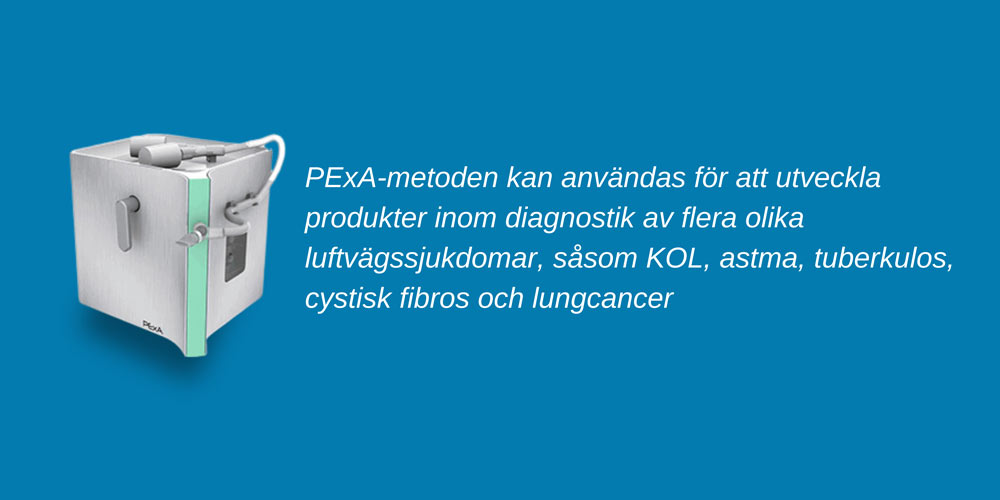
PExA has developed an instrument that is unique in the world in that it can collect biological samples from the small airways in the lungs. The small airways are the area at the very bottom of the lungs where lung diseases often start and grow before they are detected and cause problems. Because this area has historically been both difficult and dangerous to sample, there is currently limited knowledge, which PExA can now change.
The company's customers consist of actors who conduct lung research in a number of different areas. For example, they work on analyzing the biochemical composition of the small airways in order to study everything from work environment-related lung injuries to lung cancer, and the customers consist of everything from academia and university hospitals to government agencies and pharmaceutical companies. The goal is to find expressions of various lung diseases and thereby new biomarkers that can be used for early detection and thereby increase the chance of a cure. By utilizing the biomarkers that are discovered, the company's goal is to move more and more towards developing diagnostic instruments in parallel.

You provide a research instrument in lung research to identify biomarkers. Can you tell us more about the research areas where the instrument is currently being used?
Our instrument is currently used in a number of different areas by customers in Europe and the USA. Within the work environment, we have several customers such as Örebro University, Occupational and Environmental Medicine at both Gothenburg University and Aarhus University, as well as state and federal work environment authorities in Germany and the USA. For example, someone is studying lung changes when exposed to plastic and metal dust in the 3D printing industry, while others are studying how tunnel workers and those exposed to mold in homes and workplaces are affected. There is also a project at an American authority that aims to increase knowledge and the ability to diagnose TBC, which is one of the world's most widespread infectious diseases with a high mortality rate.
Furthermore, several asthma and allergy studies are underway, including at a private healthcare center chain for children in Finland and within a clinical study called RADicA, which aims to find better diagnostics for asthma at Wythenshawe Hospital in Manchester, UK.
Further examples of research and clinical studies are a pulmonary embolism study conducted at Sahlgrenska University Hospital in Gothenburg and lung cancer studies conducted at both Skåne University Hospital in Lund and Sahlgrenska University Hospital. The instrument is also used by CRO companies, i.e. actors who conduct contract research for other actors such as pharmaceutical companies and who, in the case of Fraunhofer ITEM in Hannover, also conduct their own studies with their two PExA devices.
The main focus is on studying which proteins and lipids are present in the small airways and it is also easy to examine how the content changes over time or when affected by different types of drugs. Comparisons are also made between groups of healthy volunteers and those diagnosed with the disease. This is done both to understand the composition of the lung and to analyze protein patterns in large data sets of hundreds of proteins in order to eventually distinguish between sick and healthy people. This aims to discover new biomarkers for various lung diseases in order to be able to diagnose the disease earlier in the future while it is still limited and treatable.
In which research area is your instrument most widely used, and which research area do you think will first identify patterns in biomarkers that can lead to commercialization outside the research world?
Although the instrument was originally developed in occupational and environmental medicine, where our founder Professor Anna-Carin Ohlin works, we have now gained customers in a wide range of areas. We actively want this breadth in order to use the discoveries and experiences to find cutting-edge areas where we can move from the large research market to a significantly larger diagnostic market.
What we are looking forward to with excitement right now is the publication of scientific results from the lung cancer study that is underway at Skåne University Hospital and is supported by the Swedish Cancer Foundation. We believe that this important work can become one of our future flagships that can lead both to more lung cancer studies and towards a future diagnostic application for screening and follow-up of lung cancer, which would mean enormous commercialization potential.
You currently provide the research instrument through both sales and rental. Can you describe this in more detail and tell us which method is most optimal for PExA?
We both sell and rent instruments depending on customer requirements. However, we are trying to develop our business model towards generating continuous and more predictable revenue. This could include a rental model that makes the customer's entry easier and that we can thus shorten the lead time from interest to decision. Furthermore, we are working to develop the business with the goal of taking a larger part of the value chain where we place great focus on building knowledge around biochemical analysis methods in order to later start building reference databases. We see great potential to find a large customer base within the large and broad research market where the results will be utilized to move towards diagnostic instruments with an even larger potential market.
What are some of the most important milestones PExA has recently achieved?
The most important milestones for us in recent years have been to bring in more customers and partners, while more scientific publications have been presented both in journals and as scientific posters at the largest pulmonary congresses in Europe and the USA. The company has participated for the first time with its own booth at these congresses and has thus met many potential new customers that are now being processed.
As the analysis methods for the sampled material have become both more sensitive and cheaper, more publications have shown that this sampling method can have great future significance for understanding, diagnosing, treating and following up on lung diseases. Additional milestones that have been achieved include that last year we were given the trust to sell instruments to a major American authority and that we are now also part of several international university-based consortia in lung research.
We also see it as an important milestone that the Swedish Cancer Foundation has stepped in and co-financed the exciting work underway in Lund in lung cancer screening.
What future technological improvements or innovations does PExA plan to implement in research instruments?
We have a whole bank of innovations and improvements that we are working on both technically and intellectual property-wise to be introduced into future instruments. However, the instrument we have today is optimized and scalable for the customer category that we address today. Interesting areas that we monitor and conduct development in are how to move faster from sampling to analysis through, for example, new and more sensitive biochemical analysis methods and in biosensor development.
What message do you want to convey to potential investors and stakeholders about PExA's future?
What struck me when I started working at PExA was the customers the company has managed to sell and rent instruments to, and the fantastic potential there is for both society and all people with lung disease if and when the company develops a diagnostic instrument. The fact that there is also a business in selling instruments to lung researchers along the way is a bonus.
My message to our existing and potential new owners is that they have the chance to be part of a journey where together we can enable a completely different situation in, for example, lung cancer treatment. Our vision is to be able to offer an instrument for screening and monitoring lung cancer in the future, to enable early detection, guidance for appropriate treatment and to follow up on treatment results.
Such a diagnostic tool could mean a huge change for the cancer that kills the most people in the world. For example, only 10% of patients diagnosed with lung cancer are alive after 10 years, while if the cancer is detected early, 80% of patients are alive after 20 years.
This is the reason why I both work and have invested in PExA and I welcome more people to join this exciting journey.
We thank Tomas Gustafsson for the interview and wish the company all the best in the future.
Disclaimer:
This is an interview that has been done on behalf of the company. Impala Nordic or people behind Impala Nordic owns no shares in the company at the time of the interview.

